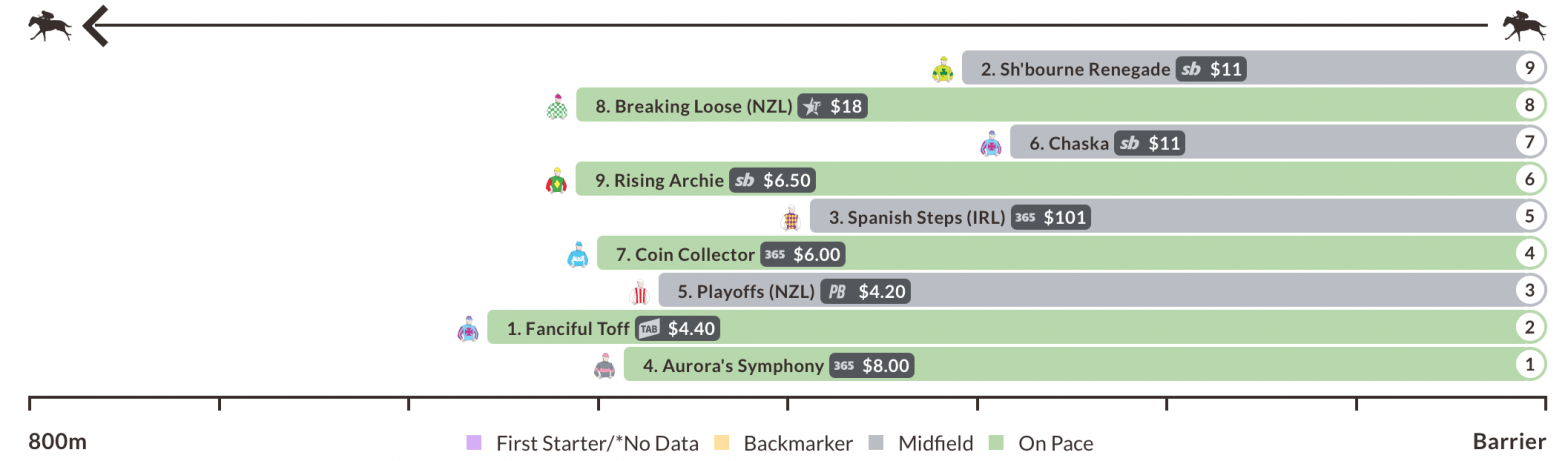
Successful punters have long known about the importance of Speedmaps – indicators of where each horse is likely to settle in the run which is an indicator to the expected tempo of the race.
Tempo is vital indicator to the outcome of a race with pace often determining the chances of a horse well before the finish.
Races run at a slow pace favour horses racing near the lead because they are able to conserve energy for the sprint to the finish, leaving horses back in the field with a mathematically difficult task to run them down in the straight.
Fast run races generally favour backmarkers. When on-pacers compete for the early lead, a fast tempo usually prevails, leaving the runners close to the pace vulnerable to tiring in the straight, setting the race up for those back in the field on the home turn to sprint home and win.
Barrier Speed
Barrier speed is an indicator of speed shown from the barriers in a horse’s previous runs which can be used as a guide to its settling position in a race.
Settling Position
The settling position speedmap uses barrier speed figures, combined with known patterns, extracted from past races, of jockeys and trainers to provide an indication of where a horse will settle, and travel, for much of the race.
Closing Speed
Closing speed is an indicator of a horse’s strength at the end of the race using data gained from finishing sectional times in past race performances.
If the speed map shows the horse on the rails likes to be up near the front then it won’t get boxed in.
If a number of horses in the race have a speed map up near the front and the favourite likes to sit back, this could be an advantage for the favourite as the front runners wear themselves out and allow the favourite to come home strongly, particularly if the favourite is a strong horse.
Track Bias
Track bias refers to the way a track races and the perceived advantages or disadvantages it holds for certain competitors.
Key terms related to track bias
On-pace bias: this type of bias will favour horses that settle on or near the speed, or at least in the first half of the field
Run-on bias: this type of bias will favour horses who settle towards the rear of the field, or in the second half of the field.
No bias: this means a track is racing fairly and that all horses have an equal chance. In these cases race tempo will be one the main factors that determines where the winner comes from.
Backmarker: horses that race at the rear of the field
On-pacer: horses that race on or near the speed
Many factors can lead to (or influence) track bias. Some tracks, by virtue of their design layout, are seen to favour horses with particular racing patterns. The finer points of this can be quite complicated but here are some basic track design principles that can affect track bias:
– The longer the straight the more chance backmarkers will have of reeling in horses that race in the front half of the field.
– The shorter the straight (especially on tighter-turning tracks!) the more likely it is to favour on-pacers.
Flemington in an example of a big, roomy track that offers all competitors an equal chance.
Moonee Valley is much smaller and trickier to negotiate, and considered by some to favour leaders
Race Tempo
Track bias can have a big impact on whether leaders or backmarkers are favoured, but perhaps the biggest factor in determining which runners are favoured is race tempo. The tempo of a race refers to the speed set by the lead horse(s).
Slowly run races: generally favour on-pacers. The reason for this is that horses racing on or near the speed (leader) are likely to have enjoyed a cushy run and can often sprint quickly and pinch a handy break on their rivals.
Fast run races: generally favour backmarkers. The reason for this is that the leaders will have exerted a lot of energy and generally tire late, allowing the swoopers – many of whom will have enjoyed some cover (protection from the wind) in the run – to swoop down the outside. Note: This is a general pattern, not a rule.